



Lobbying for and against residential developments to MPs or local councils has become a common trend and in some cases has resulted in developers being forced to rebuild refurbished properties brick-by-brick.
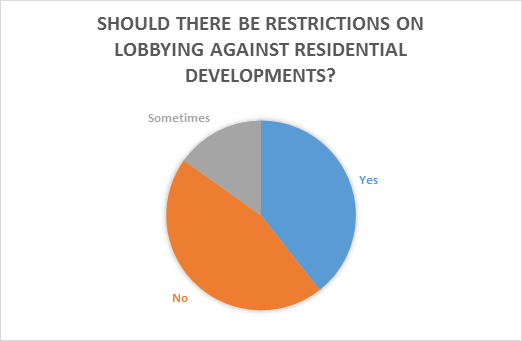
The poll conducted by Development Finance Today found 39% were in favour of restrictions, 46% voted against and 15% voted for restrictions on some occasions.
Luis McBriar of Adapt Finance felt that lobbying against residential developments should be allowed as local communities were the ones who had to deal with the strain that new developments can cause.
“They take into account the schools, hospitals etc, whereas the companies building them on the whole don’t take these into consideration.”
However, Luis did feel that the process for lobbying should be stricter.
“In some cases we see projects being delayed or denied over silly and unfounded objections.
“As I harp on about all the time, we have a housing crisis and we need to constantly build new housing, however, some people in this country don’t want this.
“For some people it’s also a hobby and a way to fill their day to complain about planning projects, we can’t go on having a system where complaints can be made so easily.
“There should be a stricter framework.”
Bob Sturges, Head of PR and Communications at Fortwell Capital, said ‘nimby-ism’ had been blamed as one of the root causes of the failure to build sufficient new homes in the UK.
“That it has a dragging effect on the planning process is probably not in question, but I think we have to be careful before changing the process so it becomes more difficult for concerned residents and local authorities to raise objections against new planning proposals.
"As a business we are firmly pro-developer, but we recognise there must exist a system of checks-and-balances to ensure against over-development and which protects and respects the rights of existing residents.
“Lobbying is one effective way to achieve this.”
Ashley Ilsen, Head of Lending at Regentsmead, added: “Before anything else is taken into account we need to streamline the planning process to give more certainty for developers, while taking into account the views of local [people] that may have developments taking place in their areas.
“I would say there's a general understanding in the country that we need more housing, and it's not just about the number of units we put up, but it's just as much as case of providing good quality stock.”
Bob added that there would always be difficulties for developers when submitting planning proposals.
“One possible solution is to accelerate the process to free-up land that is less controversial to develop, such as brownfield sites and land in public ownership.
“However, such sites are not always in the most desirable locations.”
As for other solutions to create more housing and appease local communities, Luis added: “I don’t think we can come up with a solution. As the phrase goes: ‘You can’t please all of the people, all of the time’.
“No matter what measures you put in place on the building of new housing you will always be upsetting someone.”
Bob concluded by adding he felt it was difficult to see how or why lobbying should be restricted as long as it stayed in the parameters of the law.
“Yes, we need new homes, but, surely, not at the expense of the people's legitimate right to object?
"Perhaps, therefore, we should look instead at other innovative ways to streamline our still over-complicated and bureaucratic planning process."
Leave a comment