



The economic challenges of the pandemic and the global monetary policy response continue to have a significant impact on costs. The question is whether developers or financiers should bear the burden of this.
Over the past year, prices have increased sharply, with developers often having to foot the bill.
The Office for National Statistics (ONS) reports that construction output price growth hit 6.2% in the 12 months to December 2021, the strongest annual rate since records began in 2014. Evidence continues to suggest that the rising prices of raw materials, such as steel, concrete, timber and glass, have contributed to the surge in the cost of commodities.
At the same time, the longer-lasting effects of Brexit have seen a shortage of skills in the construction industry, which has also led to wage rises.
There is a solution, however.
Price fixing
For many years, fixed-price contracts — where contractors are paid a flat amount, even when unexpected costs arise — have been an option in the property development space.
These contracts can be beneficial for developers and contractors; they allow the latter to charge a higher fee for factoring in additional work and costs, while developers have greater certainty that prices will not change further down the line.
This assurance is why many developers have been turning their attention to contracts more recently.
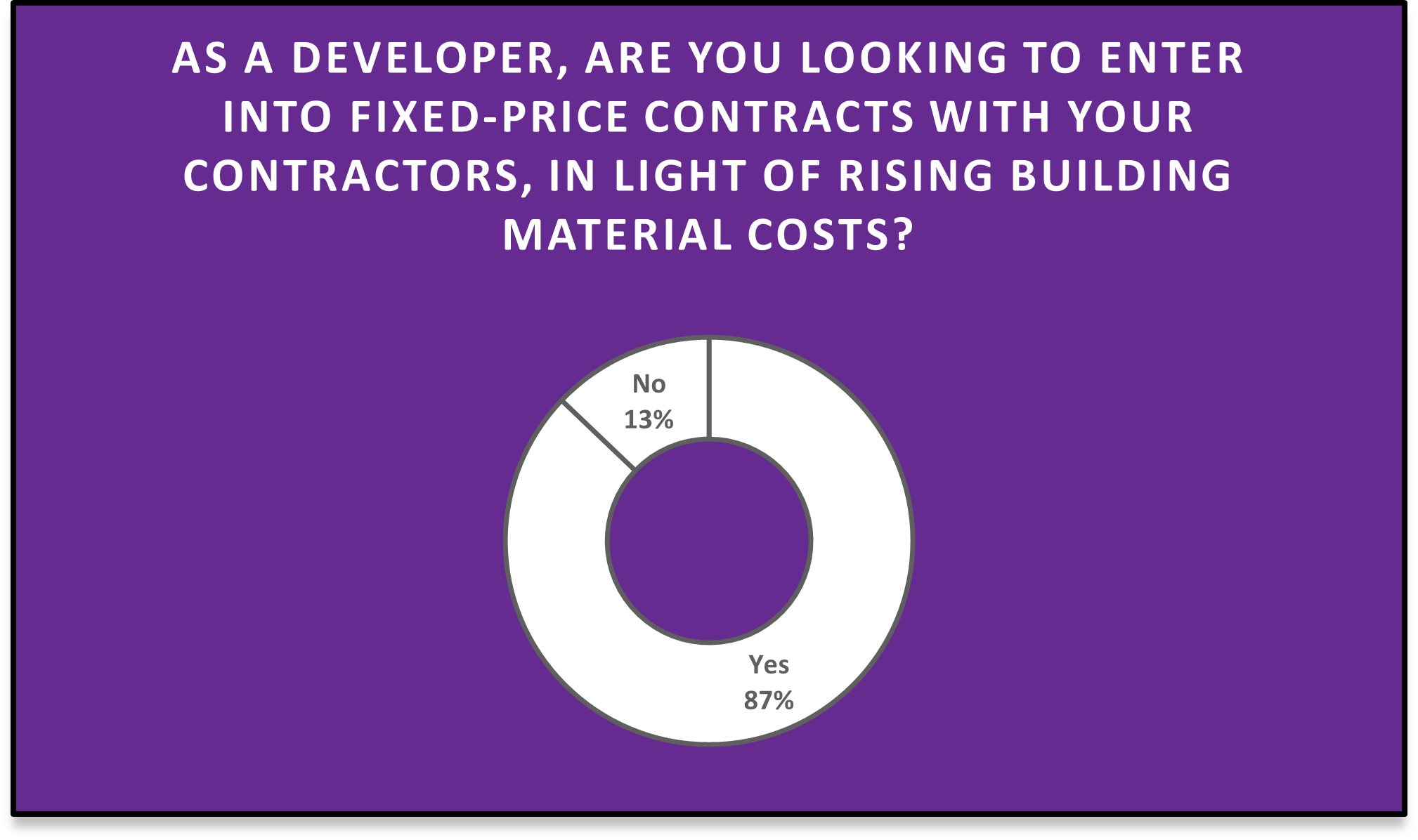
Indeed, a recent online poll by Development Finance Today, found the vast majority of developers — some 87% — are looking to enter fixed-price contracts with their contractors due to the escalating cost of building materials.
“It should come as no surprise that developers are looking to fix costs with contractors,” said Jonathan Rubins, director at Alternative Bridging Corporation. “With prices of materials on the rise because of Covid-related supply chain issues and inflation at a 30-year high, everyone in the property construction business is feeling the squeeze.”
According to equity and mezzanine finance provider Iron Bridge Finance, fixed-price contracts are the norm in terms of its expectations when considering to finance a project. Its chief operating officer, Edward Alexson, stated: “The reality is, unless the contract is design-and-build in its final form, we accept there may be some variance in the final cost. This is why we would always expect a reasonable contingency within an appraisal.”
Edward added that the nature of the market is that there is “perceived pressure for a developer to start on site as soon as possible,” allowing them to draw down funds as work progresses. "We, however, support our developers to enable them to get their design right and make the correct design decisions early on,” he explained. “This enables the ‘fixed-priced contract’ to actually be fixed, rather than being littered with provisional sums.”
For developers, contracts should be negotiated as close to securing finance as possible, commented Gareth Belsham, director and head of building consultancy at Naismiths. “It would be fairly reckless if a developer didn't agree a price with a main contractor or sub-contractor, because they would be leaving themself exposed to claims,” he detailed.
- Property investors face 'huge risk' of stranded assets if they fail to decarbonise
- Developers should use fixed-price lawyers, urges Newmanor Law partner
- Planning delays, materials and labour shortages threaten housing delivery over next 12 months
This sort of contract should ideally be comprehensive. For example, it should at least include ground works, utilities, and statutory responsibilities — areas where costs have been increasing more recently, added Edward. “We accept that provisional sums for finishes, kitchens and sanitaryware can often be necessary as, during longer projects, trends may change,” he posits. “We would, however, want the provisional allowances to be commensurate with the level of finish end-users will expect.”
Negotiations and exposure
One of the biggest challenges of negotiating a fixed-price contract is getting the timing right, and for several reasons.
Most lenders Development Finance Today spoke with agreed it was good practice for developers to de-risk a project as much as possible by fully designing it before seeking finance. That way, there should be few surprises for all parties.
Roxana Mohammadian-Molina, chief strategy officer at Blend Network, suggested that developers may want to hold off locking-in prices if they are peaking, and wait for them to fall back. “The best way to negotiate is to get multiple prices from various contractors — although the cheapest quote is not necessarily the best one,” she highlighted.
While fixed-price contracts provide greater certainty for developers and lenders, they do come with some consequences, Roxana added. “Firstly, there’s a risk that the contractor sets a much higher price to start with, in order to be able to mitigate any unforeseen circumstances that might arise, without having to bear the costs out of his or her own pocket,” she divulged. “Secondly, there’s ultimately the risk of the contractor going bust if extreme unforeseen circumstances arise that he or she is unable to deal with.”
The threat of contractors going under increased during the pandemic, as projects were put on hold to accommodate social distancing and promote self-isolation. However, even with much of the workforce now back on sites, the worry of insolvency has not gone away.
“The pandemic has effectively distressed many projects, because it was an event which wasn’t really covered in any kind of contract,” said Gareth. “What happened was, inevitably, we’d get a prolongation to the job. But somebody, somewhere, has got to pay for that — be it the client or the contractor.”
Gareth claimed that he had seen a lot of adjudications being called on to settle these projects and, unfortunately, that's taken down a large number of contractors. “That trickle of insolvencies is increasing as government support initiatives are gradually being removed. They artificially kept a lot of contracting companies in the black.”
Not just developers at risk
While fixing prices can provide greater certainty over costs, Jonathan believes that developers also need to focus on how they fund their schemes and the level of support and commitment they can expect from finance providers. “Historically, when development costs have risen, certain lenders got cold feet and withdrew from deals they’d already said yes to,” he said. “With that in mind, developers should ensure they work with experienced lenders that can provide them with competitive, flexible funding.”
However, finance providers will need to ensure they fully understand the project before committing any capital. “Any development lender worth its salt should be able to provide its own analysis of build costs when presented with a new project,” stated Ashley Ilsen, chief executive at Magnet Capital. “Current market volatility should be reflected in the need for a larger contingency on each project. Now is the right time to be sensible and back our housebuilding with basic lending principles.”
Leave a comment