



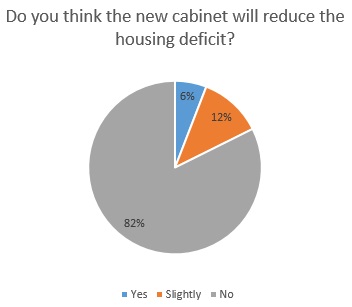
Sam Howard, chief operating officer at Regentsmead, was commenting on a poll conducted by Development Finance Today in which 82% of respondents believed the new cabinet would not reduce the housing deficit.
“We know that there is a severe shortage of houses, which has led to property prices and rents increasing significantly quicker than wages,” Sam admitted.
“My view is that the cabinet will struggle to reduce the [housing] deficit in spite of making the right noises because of the combination of the archaic planning system and the lack of available land to build on.”
Sam argued that the current planning system required a major overhaul.
“The fundamental problem is at the moment it is blighted by a lack of funds, local decision making and the effects of local ‘nimbys’, meaning housebuilders are delayed in getting planning permission and therefore new homes are not being built.
“The government needs to ensure that local planning teams are adequately staffed, but at a time when the government coffers are looking a little threadbare, the chances appear slim.”
Sam also believed that developers were hamstrung by a shortage of available land.
“The green belt is revered in this country and a policy contrary to this does not go down well with voters.
“I personally believe that it should be protected, but there should be some flexibility and the rules should be relaxed where compensation is provided elsewhere.”
Bob Sturges, head of PR and communications at Fortwell Capital, echoed the call for more land on which to build homes.
“All too often in the recent past we have seen derelict army barracks, hospitals, schools etc sold on only for luxury five-star hotels or country clubs to appear in place of the promised homes.
“Ministers must take a firmer grip.”
However, Bob admitted that the deficit may not have one simple answer.
"I think Theresa May and her colleagues are sincere about their desire to make serious inroads into the housing deficit.
“But they have a lot of catching up to do after years of empty political rhetoric and an unprecedented rise in net immigration.
“Sticky-plaster solutions are no longer good enough, and unpalatable facts need to be faced up to regarding a rapidly rising population and how it is to be housed.”
James Bloom, managing director of development finance at Masthaven, agreed that significant changes were needed
“There needs to be major reforms to planning to reduce the housing deficit, including simplifying and speeding up the process.”
Despite this, James warned that the new cabinet may be preoccupied with more pressing concerns such as Brexit and the economy.
Meanwhile, Rico Wojtulewicz, policy adviser at the House Builders Association, insisted that small-scale building projects were key to reducing the deficit.
“Many councils have focused on large sites which can take a decade to complete and in some cases be undeliverable.
“An equal focus on small sites and infill would immediately increase supply and stimulate local investment.”
Rico explained that a preoccupation with bigger sites did not only affect small developers, but also housing associations, custom builders and co-operative groups, who struggle to achieve planning.
“Mrs May stated that ‘together we will build a better Britain’, [but] in housing this means appreciating all forms of deliverable supply and not just numbers meeting paper targets.”
Leave a comment